SMERSH executes Le Chiffre
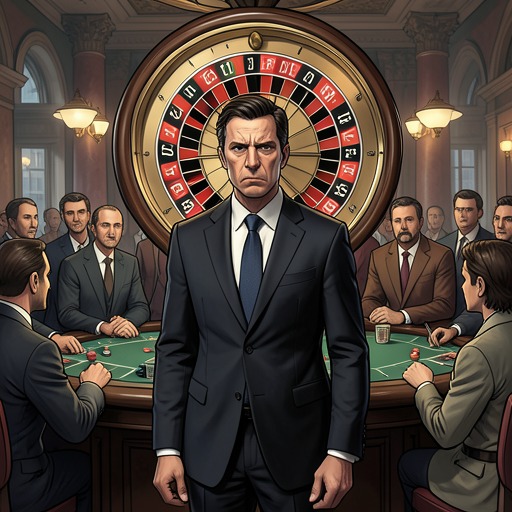
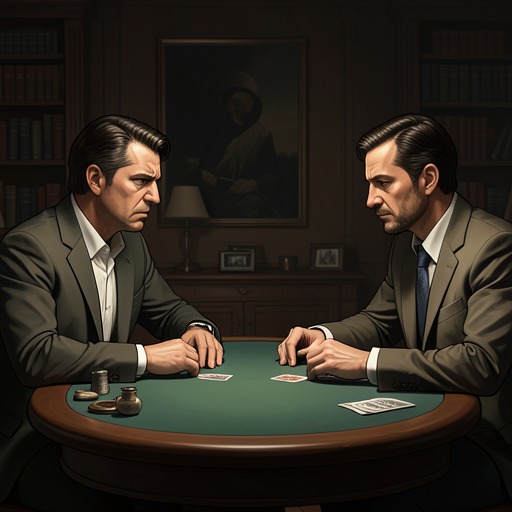
Casino RoyaleSMERSH’s execution of Le Chiffre abruptly ends the torture and the financier’s control of the room, while revealing that Le Chiffre’s own organization has judged him a traitor. Its agent kills him and leaves James Bond with a mark identifying him as a spy: the intervention saves Bond from Le Chiffre, but makes clear that his continued survival is accidental, not an act of compassion.
Arrival and Recognition
The interruption comes as an unexpected third voice breaks the exchange between Bond and Le Chiffre. Bond is barely conscious, but the quiet command to stop makes him recover enough awareness to hear the silence that follows. Le Chiffre’s expression shifts from astonishment to fear; his brief movement toward his pocket is checked, and Bond infers that a gun is trained on him. The unseen arrival is established first through the change in Le Chiffre’s behavior, before Bond can make out the newcomer.
The single word “SMERSH.” supplies the explanation. The agent identifies himself not through a name but through the organization, as though that affiliation says everything necessary. He declares that Le Chiffre’s two men are dead and calls Le Chiffre a fool, thief, and traitor. Sent from the Soviet Union to eliminate him, the agent says, he has only time to shoot; the intended punishment would otherwise have been far more painful. Le Chiffre’s financial and political failure is thus recast as betrayal of the organization whose interests he was supposed to serve.
Execution
Le Chiffre manages only a faltering denial before the agent’s judgment makes further explanation futile. The execution is swift. A small, muted report is followed by the image of a third eye appearing on Le Chiffre’s face; his body then slumps over the chair and becomes still. The contrast between the agent’s measured verdict and the abruptness of the killing gives the moment its force: Le Chiffre, who had controlled Bond through prolonged torture, is himself reduced to a condemned man with no opportunity to bargain.
The scene’s scale narrows Bond’s perspective. He cannot fully turn to see who has entered, and his understanding comes in fragments: Le Chiffre’s terror, the name of SMERSH, the shot, and finally a brief glimpse of the visitor. Bond sees glittering eyes behind a narrow black mask, a crag-like face beneath a hat brim, and a fawn-colored mackintosh before the agent pushes his head down again. The killer remains only partially identified, a representative of an organization whose power is more important here than his individual identity.
Bond Marked as a Spy
The agent tells Bond that he has no order to kill him and says that Bond’s life has been saved twice in one day, first by chance and now by mistake. The distinction denies any comforting interpretation of the rescue: SMERSH has not intervened to help Bond, and the agent says he should have been ordered to kill foreign spies lingering around Le Chiffre. Bond survives because the circumstances of the operation have not produced that instruction, not because the organization recognizes a claim on his life.
The agent turns that accidental reprieve into a threat. Because Bond is a gambler who plays cards, he may one day play against a member of SMERSH; the agent says it would be well for Bond to be known as a spy. He then cuts an inverted M into the back of Bond’s right hand. This identifying mark converts the execution’s aftermath into a message directed beyond the room: Bond is left alive, but visibly categorized as an enemy. The pain sends him back into unconsciousness, and the agent leaves without further explanation.
Consequences and Significance
The event closes Le Chiffre’s immediate story through punishment by his own side rather than rescue or victory for Bond. The agent’s account links the execution to Le Chiffre’s theft, betrayal, and the trouble he has caused, while the reference to his dead men shows that his operation has collapsed. Yet Bond’s predicament remains unresolved: although Le Chiffre can no longer torture him, Bond is still bound to the chair, badly weakened, and now marked for recognition by SMERSH.
The episode reverses the apparent balance of power without offering a clean release. Le Chiffre’s victim becomes the witness to his execution, but Bond has not engineered the reversal and cannot control what follows. The agent’s explanation insists on the contingency of survival, and the mark on Bond’s hand carries that lesson forward: in the contest with SMERSH, being spared can itself be part of the danger.